
Climate Law and Governance Day
Climate Law and Governance Day 2025
CLGD 2025 Full Programme
CLGD 2025 Proceedings Report
CLGD 2025 Session Recordings
CLGD 2025: Highlights and Outcomes Statement
Leadership from Climate Law in Practice 2025
About Climate Law and Governance Day 2025
The Paris Agreement at 10 – Advancing Climate Courage, Contributions & Compliance
With leading climate law and governance counsel, experts and practitioners preparing to join over 20,000 Party delegates and observers for the United Nations Framework Convention on Climate Change (UNFCCC) 30 Conference of the Parties (COP30) in Belem, Brazil on 10 November – 21 November 2025, a unique opportunity arises to increase ambition, harness the knowledge and engagement of the climate law and governance community, share innovations and good practices, and strengthen networks and capacity for ambitious climate action.
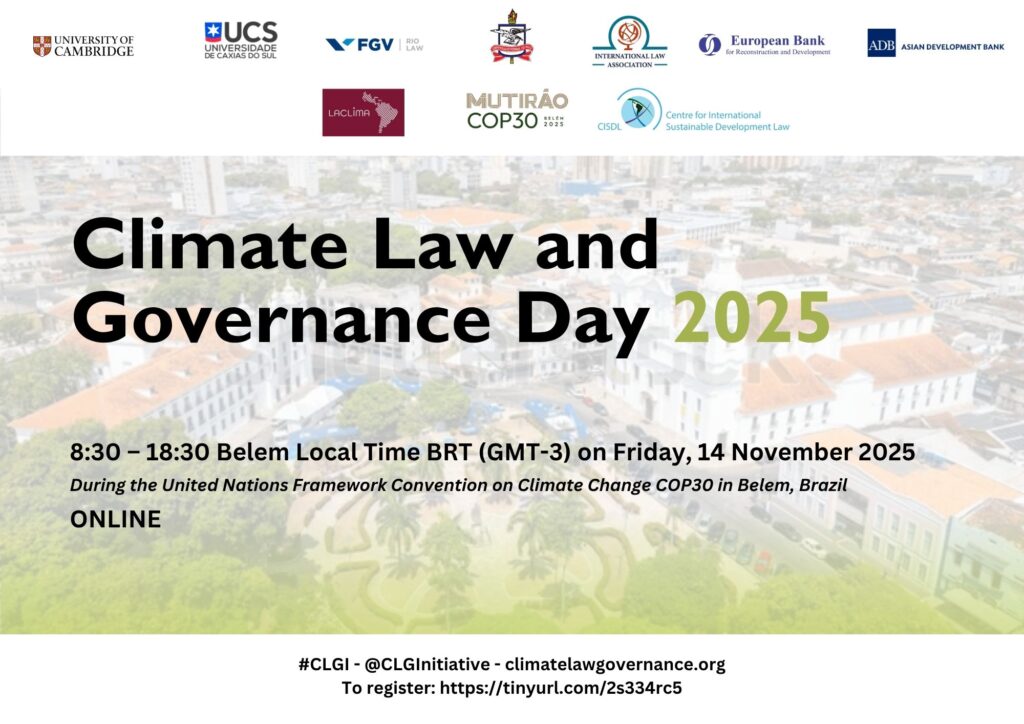
To deliberate on these critical issues, Climate Law and Governance Day (CLGD 2025) was held on Friday, 14 November 2025 during the 30th Conference of the Parties to the United Nations Framework Convention on Climate Change. The event was co-hosted by Universidade de Caxias do Sul (UCS), Federal University of Para (UFPA), FGV Law Rio in Brazil and the University of Cambridge in the UK, along with many international organisations and other partners. This full-day global symposium featured distinguished plenaries, celebratory launching events, also up to 12 world-class specialist panels and workshops.
Overview
- How can legal and institutional innovation accelerate the implementation of the Paris Agreement at its ten-year mark?
- What role can climate law and governance play in scaling ambition, strengthening compliance, and ensuring accountability across all levels of society?
- In what ways can law and justice together foster equity, resilience, and a just transition for the most climate-vulnerable communities worldwide?
On the tenth anniversary of the Paris Agreement, CLGD 2025 aimed to inspire and optimise legal and institutional reform for achieving current Nationally Determined Contributions (NDCs) under the Paris Agreement. We considered Global Stocktake outcomes, climate finance, and increasing the ambition of the next round of NDCs. The objectives of the symposium include identifying and sharing innovative international, national, and local law and governance challenges, mechanisms and good practices relating to global efforts to address climate change. By convening esteemed legal and public policy experts, judges, negotiators, professors and practitioners from around the world that are committed to implementing the Paris Agreement, CLGD 2025 sought to catalyse knowledge exchange and co-generate new climate law and governance scholarship, insights and approaches, facilitating new dialogue and partnerships. The symposium further aimed to strengthen capacity and collaboration among the climate law and governance community of practice to implement the Doha Amendment, Paris Agreement and COP outcomes, supporting achievement of the world’s Sustainable Development Goals (SDGs).
CLGD 2025 Themes
The Paris Agreement is ten this year. This year’s symposium focussed on the following four key themes, which were identified in consultation with the CLGI Programme Committee based on the vision and goals to enhance ambition and enable action set by Brazil as the UNFCCC COP30 Presidency, as informed by the UNFCCC 62nd Subsidiary Bodies meetings in June 2025:
- Operationalising the Paris Agreement at 10: Contributing to the “Baku to Belem Roadmap” by strengthening measurable progress across sectors; prioritising forests as nature based solutions, recognizing their role as critical carbon sinks and biodiversity reservoirs, and advancing ecosystem based approaches essential for climate resilience and global mitigation efforts; advancing the operationalisation of Article 9 and the Loss and Damage Fund as well as adaptation indicators regarding the Global Goal on Adaptation (GGA); enhancing transparency, the Global Stocktake (GST), technology transfer, and capacity-building through the UNFCCC/Paris Agreement implementation architecture (COP/SBs, global dialogues, expert groups, implementation and compliance committee), as well as through complementary international regimes such as UNCLOS, CBD, and IMO.
- Scaling Up National Climate Ambition and Action through Law and Governance: Innovating high ambition instruments for climate mitigation, adaptation and resilience, and finance; creating multilevel governance synergies within and across sectors; advancing local, regional and national carbon budgets, planning rules and regulations; assessing legal barriers and strengthening capacity amongst leaders, practitioners and advocates for NDCs/NAPs/LTs delivery. Strengthened legal coherence and integration across policy frameworks is essential to ensure implementation at scale and alignment with the Paris Agreement and global climate goals.
- Advancing Climate Justice: Engaging civil society and the legal community, courts, law associations and others in raising climate ambition and accelerating climate action, enhancing transparency and ensuring accountability, integrating rights-based approaches, advancing loss and damage response, supporting access to climate justice and climate litigation, and addressing climate migration and intergenerational equity. Leveraging advisory opinions from international and regional courts can clarify legal obligations, while embedding human rights at the core of climate governance ensures that climate responses are equitable and just.
- Deploying Law and Legal Instruments for Investing in Just Transition: Harnessing law on all levels and commercial legal instruments to leverage the NCQG for mobilising all finance flows for investment in climate mitigation, adaptation and resilience; scaling up re-allocation of capital and sustainable global supply chains, and addressing fossil fuel subsidies, climate risk disclosure, a just transition and decarbonisation, especially through private, trade, investment and competition law, and through commercial and corporate rules. Legal tools must also be used to ensure that trade policies support sustainability goals, that environmental labels are credible and enforceable, and that greenwashing is effectively prevented through robust regulatory frameworks and corporate accountability.
More About the Symposium
Climate Law and Governance Day 2025 builds on a series of special events co-hosted by key partners from the Climate Law and Governance Initiative (CLGI) during the UNFCCC climate conferences since the 2005 MOP1/COP11 in Montreal, Canada to mobilise the international law and governance community to help implement the UNFCCC and most recently, the Paris Agreement in the context of the global Sustainable Development Goals. This global symposium aims to facilitate meaningful dialogue between COP delegates, observers, stakeholders, students, and others with a keen interest in national and international law and governance related to climate change.
Climate Law & Governance Day 2025 Video Resources
Ten Years from the Paris Agreement: MDBs’ Sui Generis Mutirão – Stocktaking, Reflecting and Strategizing (from CLGD 2025 High-Level Plenary II). To watch, please click here.
Inspiring Climate Law in Practice (from CLGD 2025 High-Level Plenary III & Closing). To watch, please click here.
On addressing climate challenges in international courts, adjudication and conciliation:
- The Climate Justice Turning Point – From Advisory Opinions to Accountability Online Roundtable. Hosted by World’s Youth for Climate Justice; Pacific Islands Students Fighting Climate Change & Bangladesh Society of Intl Law. To watch, please click here.
- Assessing the Implications of the ICJ and Other Climate Advisory Opinions for the Private Sector Online Roundtable. Hosted by Brazilian Bar Assoc Rio Grande do Sul Chapter OAB/RS, Enviro Law Comm; Tauil&Chequer/Mayer Brown; Univ de Caxias do Sul UCS Brazil; Intl Bar Assoc IBA; American Bar Association ABA; British Institute of Intl & Comp Law BIICL. To watch, please click here.
- Adjudicating Climate Disputes in a New Era – Implementation and Conciliation Online Roundtable. Hosted by Intl Council for Commercial Arbitration ICCA & Grantham Research Institute on Climate Change & Enviro, LSE; Global Network for Human Rights & Enviro GNHRE; Université Laval; Caribbean Enviro Law Unit, Univ West Indies – Cave Hill. To watch, please click here.
On aligning finance and investment with climate and nature imperatives:
- Enabling Climate and Nature Finance for Resilient Futures – From Law to Leverage Experts and Practitioners Roundtable. Hosted by the European Bank for Reconstruction and Development (EBRD) Legal Office. To watch, please click here.
- Advancing Legal and Regulatory Readiness for Climate Financing and Bondholder Engagement Online Experts Panel. Hosted by the Karachi Center for Climate Change, Sohail Univ; Ministry of Climate Change, Pakistan; Securities & Exchange Commission of Pakistan; Bank of Punjab & Anthropocene Fixed Income Institute AFII. To watch, please click here.
On mobilising law and governance capacity for climate action and more just transitions:
- Building Capacity for Climate Governance and NDC Implementation Roundtable. Hosted by CISDL; Democratising Education for Global Sustainability and Justice DemEd Global & Hughes Hall Centre Climate Engage CCE, Univ Cambridge; HBKU, Qatar; Law, Univ Witwatersrand. To watch, please click here.
- Leveraging National Legal Frameworks for Just Transition Legal Roundtable. Hosted by the World Bank, UN Enviro Programme & UN Dev Programme. To watch, please click here.
- Just Transition in the Age of Artificial Intelligence – Reconciling Climate Action, Workforce Reskilling and Smart Public Governance Online Roundtable. Hosted by Varsovia Univ Business & Applied Sciences, Poland. To watch, please click here.
On protecting forests and food systems through climate law and policy:
- Governing Forests & Farming Futures – Advancing Climate Justice in Africa Online Roundtable. Hosted by ADIFEVEA World & Reseaux des Juristes Environnementaliste de l’Afrique Centrale REJEAC. To watch, please click here.
- Processing vs. Performance – Legal Pathways for Sustainable, Nutritious, and Affordable Food Systems Legal Roundtable. Hosted by International Flavours and Fragrance (IFF). To watch, please click here.
On advancing climate justice in respect to loss and damage, and defending defenders:
- Advancing Climate Justice – Reimagining Accountability, Climate Displacement and Equitable Loss and Damage Responses Legal Roundtable. Hosted by Loss & Damage Youth Coalition, School of Oriental & African Studies SOAS Univ London & Global Choices. To watch, please click here.
- Defending Climate Defenders – Climate Litigation, Compensation and the Legal Mobilization of Local and Indigenous Communities Interactive Workshop. Hosted by LACLIMA. To watch, please click here.
Past Climate Law & Governance Day Reports